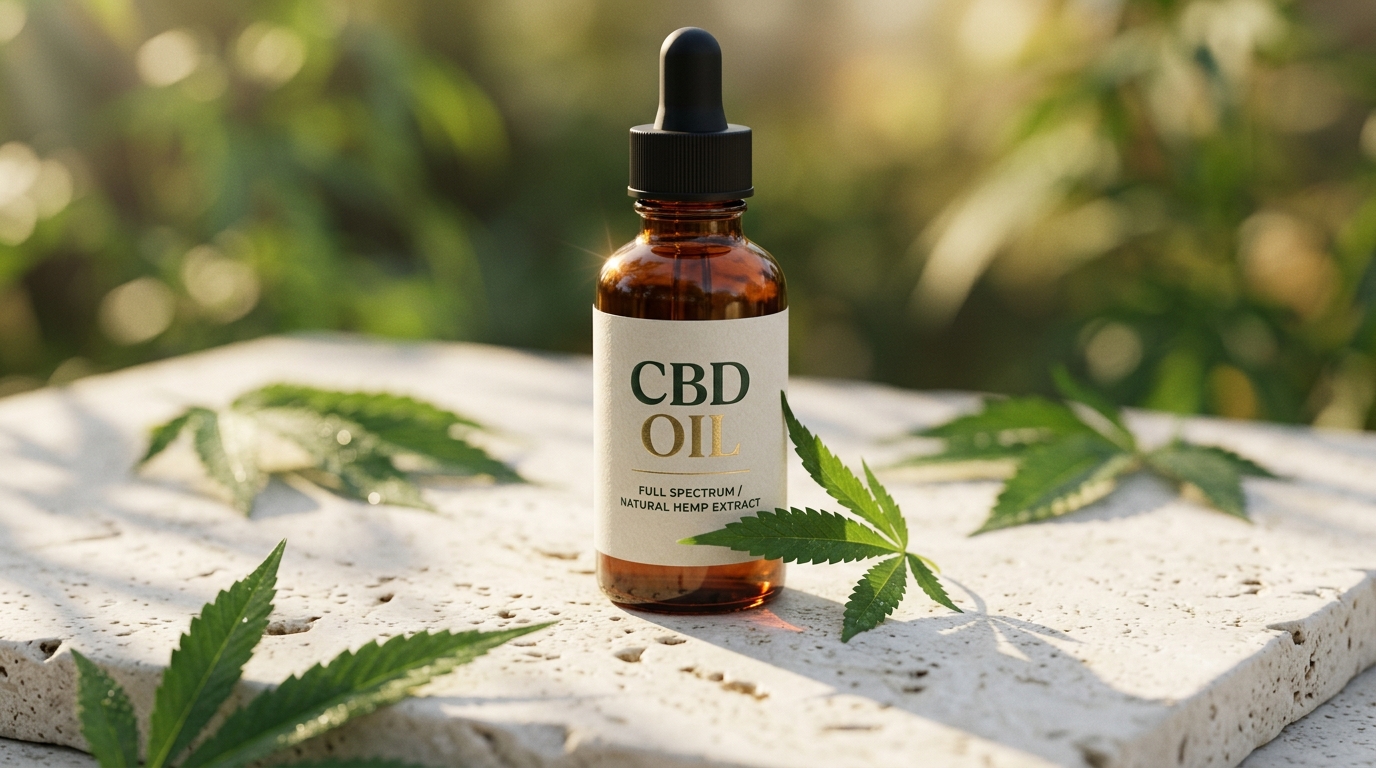
Walk into a pharmacy or open any online store and a row of small dropper bottles appears. Most are labeled CBD oil, and the labels rarely agree on what that means. Prices run from a few dollars to well over a hundred, and the claims range from careful to wild. A little background makes the shelf much easier to read.
What CBD Oil Is Made Of
From hemp plant to dropper bottle
CBD is short for cannabidiol, one of more than 100 cannabinoids found in the cannabis plant. Nearly all retail products come from hemp, which U.S. law defines as cannabis containing no more than 0.3 percent delta-9 THC by dry weight. The 2018 Farm Bill wrote that definition into federal law and removed hemp from the list of controlled substances. THC is the compound behind the “high.” CBD does not cause one.
Makers pull the cannabinoids out of the plant with CO2 or ethanol, then blend the extract into a carrier oil. MCT oil (usually from coconut), hemp seed oil, and olive oil are the usual choices. The liquid in the bottle is mostly carrier oil. A 30 mL bottle with 1,000 mg of CBD, for example, is only about 3 to 4 percent CBD by weight.
No secret ingredient. No special process beyond how well the extraction and testing are done.
Full spectrum, broad spectrum, and isolate
Three labels show up again and again, and they describe what else travels with the CBD.
| Type | What it contains | THC level | Who tends to pick it |
|---|---|---|---|
| Full spectrum | CBD plus other cannabinoids, terpenes, and flavonoids | Trace amounts, up to 0.3% | People who want the whole-plant profile |
| Broad spectrum | CBD plus other cannabinoids and terpenes | Usually removed or below detection | People who want variety without THC |
| Isolate | CBD alone | None intended | People who must avoid THC entirely |
Trace THC can add up with heavy daily use, which is why people who face workplace drug screening often lean toward isolate. Broad spectrum products sit in the middle, though “THC-free” claims are only as good as the lab report behind them.
What the Research Says So Far
One approved drug, many unproven products
The strongest evidence belongs to a single prescription medicine. In June 2018 the FDA approved Epidiolex, a purified CBD solution, for seizures linked to Lennox-Gastaut syndrome and Dravet syndrome. Tuberous sclerosis complex was added in 2020. The trials behind it dosed by body weight, at 10 and 20 mg per kilogram per day. For a 70 kg adult, the higher dose works out to 1,400 mg a day, which is more than an entire 1,000 mg retail bottle.
That gap matters when reading product claims. Results from a pharmaceutical dose in a specific seizure disorder do not transfer neatly to a few drops of an over-the-counter oil.
The FDA has not approved nonprescription CBD products for any condition. The agency has also raised safety questions about them, including the potential for liver injury, and it has sent warning letters to companies making disease claims.
Who uses it and why
A Gallup poll released in August 2019 found that 14 percent of U.S. adults said they use CBD products. Pain was the most common reason given, followed by anxiety. The survey is a few years old now, and usage habits may have shifted, but it remains one of the most cited snapshots of how widely these products are used.
Studies on anxiety, sleep, and pain do exist. They tend to be smaller and shorter than the epilepsy trials, and their results are mixed.
Side effects and cautions
Reported side effects in clinical studies and FDA material include:
- Drowsiness or fatigue
- Diarrhea
- Reduced appetite
- Raised liver enzymes, mostly at higher doses
- Interactions with medicines processed by the liver, including the blood thinner warfarin and some seizure medications
A 2018 World Health Organization review found that pure CBD showed no signs of abuse or dependence potential and was generally well tolerated. Good news, with a catch: the review covered pure CBD, and retail products vary in what they actually contain. People who take prescription medication, are pregnant or nursing, or have liver conditions should talk to a doctor or pharmacist before trying any CBD product.
How to Choose and Use a Bottle
Start with the lab report
Here is the uncomfortable part. A 2017 study in JAMA, led by researchers at the University of Pennsylvania, bought 84 CBD products online from 31 companies and tested them. About 26 percent contained less CBD than the label stated. About 43 percent contained more. Only about 31 percent landed within 10 percent of the claimed amount. THC turned up in roughly 21 percent of the products.
That is why a certificate of analysis (COA) is worth the two minutes it takes to read. A good one is batch-specific, comes from an independent lab (ideally accredited to ISO 17025), and lists:
- Cannabinoid potency, which should match the label
- THC content
- Pesticide results
- Heavy metals
- Residual solvents
- Microbial contamination
The batch number printed on the bottle should match the number on the report. If it does not, or if no report exists, move on.
Do the math on strength
Labels usually list total CBD in the whole bottle, not per serving. Take a 30 mL bottle with 1,000 mg of CBD. Divide 1,000 by 30 and the result is about 33 mg per mL. A full dropper (1 mL) delivers around 33 mg, and half a dropper delivers around 17 mg.
Price works the same way. A $50 bottle with 1,000 mg costs 5 cents per milligram, while a $30 bottle with 300 mg costs 10 cents. The cheaper-looking bottle can be the pricier one.
A quick checklist for comparing labels:
- Total CBD in milligrams and the serving size
- Type: full spectrum, broad spectrum, or isolate
- Carrier oil and any added flavors or sweeteners
- Extraction method
- Batch number with a matching lab report
Forms, timing, and a slow start
Oil is only one format. Capsules, gummies, and topicals also exist, and each behaves differently. Oil held under the tongue tends to act within an hour. Capsules and gummies take longer because they pass through digestion first. Topicals stay on the skin and are a different category altogether.
Many product labels suggest starting with a small serving, often in the range of 10 to 25 mg, and holding the oil under the tongue for 60 to 90 seconds before swallowing. A simple notebook helps: write down the date, time, serving size, and any effects for two weeks before changing anything. One variable at a time gives the clearest picture.
Legal rules differ by country and by U.S. state, and CBD that is legal at home can be restricted elsewhere. Anyone traveling with it should check local regulations first.
Final Thoughts
CBD oil is a simple mixture, a cannabinoid extract in a carrier oil, and most of the confusion comes from labels and loose claims. The research is strongest for one prescription drug and thinner for everything sold off the shelf. A batch-specific lab report, a clear milligram count, and a slow start give a first-time buyer the most to work with. Anyone on medication or with a liver condition should talk to a doctor first.
Related video: